The new Gatsby website has been soft launched for a couple weeks now and seems to be working pretty well so far, so I’m now moving on from building out the site to building out a bunch of tools for sending out notifications of new content. My hypothesis here is that if I can make the barrier to entry as low as possible for people to get notified of new posts, they’ll be more inclined to read them, and that means going where people already are. Obviously RSS is a great technology for this, but it never really recovered from Google Reader meeting its far too early demise. People use algorithmic news apps, social networks, chat apps, and more to find and share posts, and so that’s where I need to be.

So far I’m planning on distributing posts to:

  • RSS/Atom/JSON feeds
  • A Twitter account
  • A Telegram channel
  • Medium
  • Flipboard
  • Apple News
  • Email
  • Mastodon

I’m a big believer in making a bunch of little systems that work together rather than one big monolithic system. I chose to build this project using the Serverless framework built on Amazon’s AWS technologies like Lambda. I really didn’t want to manage keeping processes alive and setting up things like cron jobs, so this makes a lot of sense. There are also a few other endpoints I want to implement later for the site like Micropub and Webmentions which would be nice to have managed through Lambda rather than running forever on some VPS somewhere.

Once it’s working, the basic pipeline looks something like this:

  1. I create a post (or make some change the site) and commit it to a Git repo
  2. I push the repo to my GitLab server
  3. When GitLab receives a commit, it kicks off a CI job to build the site and deploy it.
  4. Once deployed, it sends a message to an AWS Lambda function to signal the site has changed.
  5. The function on Lambda downloads a copy of the current website data and a copy of the last seen website data from AWS DynamoDB
  6. New and updated posts are sent to a WebSub server (you might remember this as “PubSubHubbub”) to signal to anyone who subscribes that the page changed. (Which means that, once this is working, the entire site will support WebSub as a server-to-server push mechanism!)
  7. New posts are inserted as rows into a DynamoDB table
  8. A series of AWS Lambda functions will be listening for insert events on that table, one for each service listed above, and they will farm out the API calls to each service

I like this approach because it’ll hopefully mean there is some resilience to normal maintenance things like server restarts and database failures. It fits nicely with a lot of open standards being pushed by the IndieWeb movement. And it’ll be automatically integrated into the build process, so I won’t forget to actually do the crossposting. It’s already well underway with a lot of the infrastructure in place; steps 1-5 and step 7 are all finished. All that’s left is to set up the individual integrations with each service and connect the WebSub plumbing.
rip

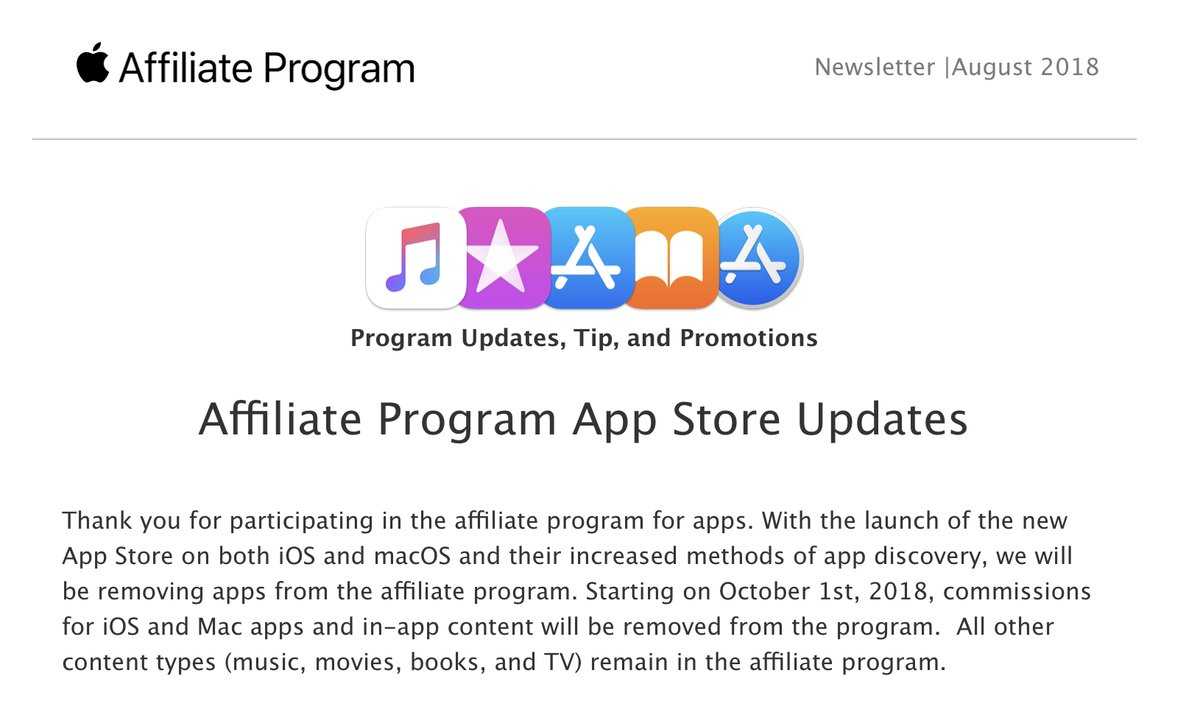
Apple, who just yesterday announced a $53 billion profit in a single quarter (driven largely by the iPhone and its App Store), is shutting down the affiliate program for the App Store. Meaning blogs that cover the App Store and highlight great apps will no longer be able to get paid for driving traffic. With only 60 days notice, Apple will stop paying developers for the traffic they’re already sending and just take the money for themselves.

I don’t know how to view this as anything other than a “screw you, we got ours” move. Apple has the cash to run this program into perpetuity. With the App Store in the millions of apps, there is always room for more voices of curation, because the most valuable marketing is word-of-mouth. Developers won’t see lower rates and customers won’t see lower prices. There is no upside to anyone here except Apple, the richest company on the planet. It doesn’t make any sense.

Eli Hodapp of TouchArcade:

I don’t know how the takeaway from this move can be seen as anything other than Apple extending a massive middle finger to sites like TouchArcade, AppShopper, and many others who have spent the last decade evangelizing the App Store and iOS gaming.

Federico Viticci:

I am personally not that affected because we saw this coming years ago and we adapted – but it’s a huge blow to small publications, indie devs, and others who rely on this to earn commissions. Sad.

Daily reminder that if you truly want your favorite blog to stick around, make sure to support them directly, whitelist them for ads, buy through their podcast sponsors, etc.

Shawn King:

This has the potential to kill sites like Touch Arcade that use the revenue from App Store affiliate links to stay afloat. I think Apple’s stated reasoning for this action is utterly ridiculous and complete bullshit. But it also shows the danger for any site or business to rely too much on one source of revenue.

Greg Pierce:

The affiliate program was not huge for me, but it was a nice small check every month. I imagine this will particularly hurt small blog/news sites that do a lot of app coverage, however.

Apple’s quarterly results showed the Mac down 13% year-over-year. Everything was out of date; the new MacBook Pros didn’t ship until Q3 in July, so that certainly didn’t help. John Voorhees also has some handy charts over at MacStories.

I really hope Apple starts to get the Mac back in shape soon. They showed a relatively strong offering of Mac software at WWDC, probably the most exciting since the reveal of the trash can Mac Pro in 2013.

TypeScript (and its integration with Visual Studio Code) are doing amazing things for developer productivity and reliability with JavaScript. I originally used Flow for type-safe JavaScript, but I’m really seeing a lot more benefits from TypeScript, and have been making new projects (including this site) in it.

Also, it’s getting really popular.

I got a time of 26 minutes 21 seconds, with 73 deaths. I kicked a couple bucks to the developer. Check it out.

Of all the companies to acquire GitHub, Microsoft is probably the best. What was a critical piece of internet infrastructure held up under a venture capital model will now at least be sustained by one of the biggest tentpole companies in the software industry. They will presumably be able to bring some organizational support and work to shore up the sites notoriously rocky reliability. And a company like Microsoft will hopefully not be able to shrug off a sexual harassment claim the way GitHub did.

I don’t see this alleviating a major problem with software engineering culture, the over-reliance on GitHub as a centralized home of code. Git is distributed by nature and most of the value added by GitHub (PRs, issues, wikis, etc.) are found on competitive platforms like GitLab and Bitbucket. But many companies rely exclusively on GitHub, and many tools like Travis CI support GitHub exclusively. Competition makes everyone better, and Microsoft will probably use its existing platforms to further lock in developers and companies and reduce competition.

I personally use a self-hosted instance of GitLab on my VPS server (which is quite easy to install nowadays), which provides me with all the features I would want and an unlimited capacity of private repositories. I use it for continuous integration and continuous deployment with its built-in Docker image registry, and those images get deployed automatically to servers. I’m hoping to do a tutorial on setting that up.

Interesting timing with WWDC kicking off tomorrow, though.

I adore this YouTube series. While I personally thought The Last Jedi was one of the strongest entries in the series because of how daring it was, this video certainly points out some aspects of Finn’s character arc that I hadn’t considered as much.

The Vintage Computer Festival celebrates old computers from the 70s, 80s, and 90s. It was held February 10th and 11th, 2018, at the Living Computers Museum and Labs in Seattle, WA. I spent the afternoon checking out old computers, playing games, and hearing from living legends who brought these computers to life. Come on the adventure with me, and check out the museum if you’re ever in the Seattle area!

LG’s V series phones have been enthusiast-class Android devices that have always flown a little under the radar, never quite escaping the shadow of phones like the Galaxy Note or the Nexus/Pixel. But the latest entry, the V30, is a very impressive phone that should be on your list of devices to consider, even if it’s not perfect.

The just-launched LG V30 has finally arrived! This new flagship Android phone from LG is gorgeous and packed with features. In this video, we’ll take it out of the box, show everything included, and get it booted up to the first launch. Full review of the LG V30 to follow, so make sure to subscribe!